
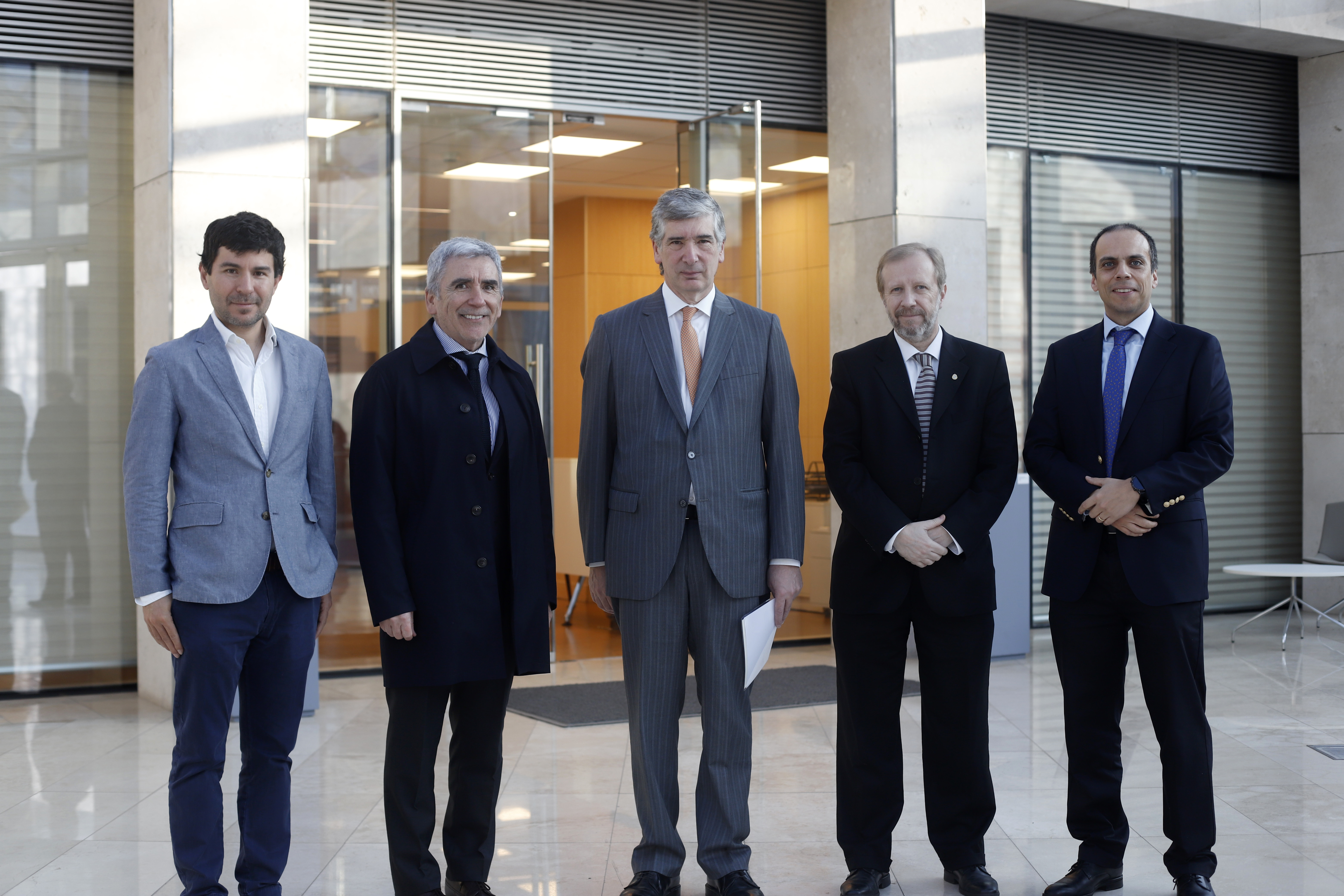
The Human Development Lab organized the seminar “Highly Selective Universities: How Do They Contribute to Social Mobility and Elite Formation?”, bringing together university presidents and academics to reflect on the role of higher education institutions in human capital development and their potential as drivers of social mobility.
The event featured José Antonio Guzmán, President of Universidad de los Andes; Francisco Gallego, Vice President for Institutional Management at Pontificia Universidad Católica de Chile; Carlos Peña, President of Universidad Diego Portales; and Jesse Rothstein, Professor of Public Policy and Economics at UC Berkeley. The discussion was moderated by Andrés Barrios Fernández, Director of the Human Development Lab UANDES and faculty member at the School of Economics and Business, and was sponsored by Banco de Chile.
During the seminar, Carlos Peña emphasized the need to rethink admission systems in order to make them more equitable. “A fair model would assign higher education slots to those who most deserve them based on effort and achievement. However, many of those merits depend on external factors such as family background, social class, or cultural capital. Without concrete institutional efforts, social mobility will not materialize,” he stated. In this context, he shared the experience of Universidad Diego Portales, which has implemented special admission and support programs for students from public schools, showing positive results in graduation rates and academic performance.
Francisco Gallego highlighted the importance of opening complementary admission pathways beyond standardized tests. “Chilean talent is not being identified solely through exams such as the PAES. Nearly 20% of our students now enter through alternative pathways, and one-third do so with tuition-free education. The challenge is to move toward alternative admission mechanisms that strengthen social mobility,” he noted.
José Antonio Guzmán underscored the importance of expanding access opportunities and student support, as well as considering the broader social impact of universities. “At UANDES, 18% of our students come from public and publicly subsidized schools, and we offer scholarships and support programs that result in nearly identical graduation rates between students admitted through regular and special admission tracks,” he explained.
He also stressed that universities should not focus solely on academic performance, but also on students’ holistic development and social integration. “Beyond academic training, the environment in which students develop, the networks they build, and the personal and professional connections they form at university play a decisive role in social mobility. In our view, university education must serve the common good by training ethical and socially responsible leaders with a genuine commitment to society,” he added.
The seminar concluded with a shared call to rethink admission mechanisms and to reinforce the role of universities as agents of change, contributing effectively to social mobility and the formation of socially responsible elites.


