
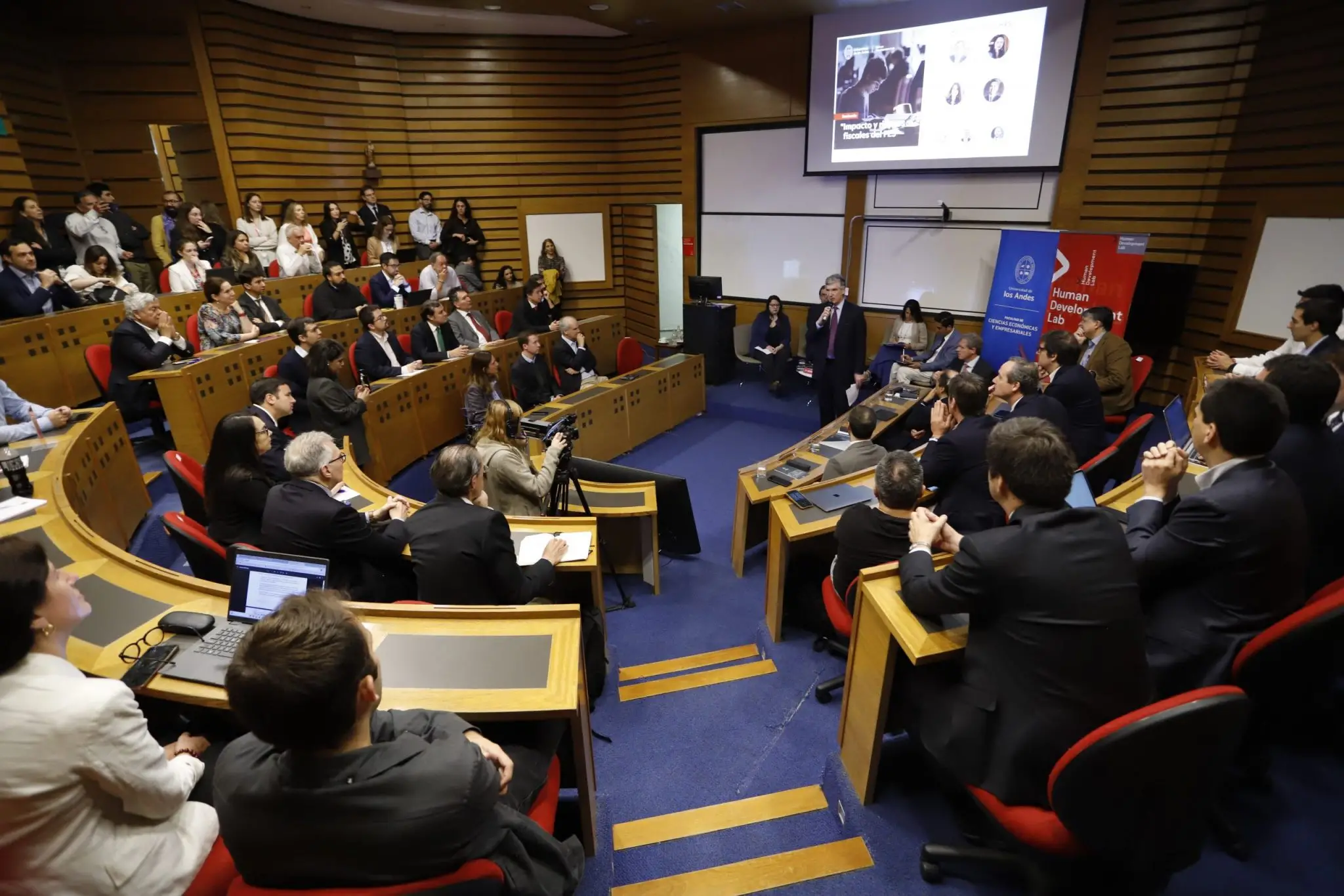
Authorities and experts in public finance and higher education gathered at Universidad de los Andes to discuss the fiscal implications and key challenges of the proposed Student Funding System for Higher Education (FES), a bill intended to replace Chile’s current student loan system (CAE).
The seminar, “Fiscal Impact and Risks of the Student Funding System for Higher Education (FES)”, was organized by the Faculty of Economics and Business in collaboration with the Human Development Lab. The discussion addressed the project’s fiscal risks, its impact on universities, and the conditions required to ensure its long-term sustainability.
Opening the event, Rector José Antonio Guzmán emphasized that the proposal raises fundamental questions regarding the financial sustainability of the higher education system. “We cannot completely dispense with private financing in higher education. We must ask ourselves what role we want the State to play—whether it should provide more direct funding to universities or move toward a more equitable scheme,” he stated.
From a fiscal perspective, Minister of Finance Nicolás Grau warned that maintaining the status quo entails significant risks. “By far, the greatest fiscal risk is doing nothing,” he said, noting that the current system has ceased to function effectively and that private banks have withdrawn from it. “We are under fiscal stress, but maintaining the status quo is worse. The political moment to move forward is now, because these reforms are difficult and require agreements.”
Javiera Martínez, Director of the Budget Office (Dipres), highlighted that the State currently allocates close to US$800 million annually to the CAE and stressed that any reform must consider that baseline. “We are not legislating on a blank page,” she said. While arguing that the FES improves the fiscal position and updates a system that has lost private-sector participation, Martínez acknowledged that the proposal presents conceptual challenges. “It is a financial instrument that does not currently exist; it is not simply a loan. This explains part of the public debate.”
Invited economists offered diverse perspectives. Ignacio Briones described the FES as “a new tax on graduates” and questioned its incentives, noting that “40% of graduates will end up paying more than they would under a traditional loan.” He also warned of a US$500 million deficit during the first decade of implementation. “Governing is about setting priorities. We must ask how many benefits we want to finance in a country facing poverty and a housing deficit. We cannot say that this project performs miracles and costs less than it really does,” he said.
Andrea Repetto, Director of the School of Government at the Pontificia Universidad Católica de Chile, agreed on the need for reform but urged caution regarding the associated risks. “The project is necessary, but it creates excessive dependence on the State and replaces private resources with public ones,” she noted. Repetto also criticized the fiscal analysis window of the proposal, stating that “a 10-year financial report is insufficient for a project of this magnitude; it does not have time to stabilize.”
Matías Acevedo, a faculty member of the Faculty of Economics and Business, questioned the financial structure of the FES and the assumptions underlying its balance. “If this system were a loan, its interest rate would be below zero,” he stated, adding that the proposal assumes a default rate of 0%, which he considered unrealistic. “If we assume a 10% default rate, the cash flow changes dramatically.” He also warned that underestimating costs could ultimately affect students: “If we fail to minimize costs, students will be the ones harmed.”
The seminar concluded with a shared view among panelists that Chile faces a critical decision regarding the future of higher education financing, underscoring the importance of carefully assessing the fiscal and institutional implications of any reform.


