
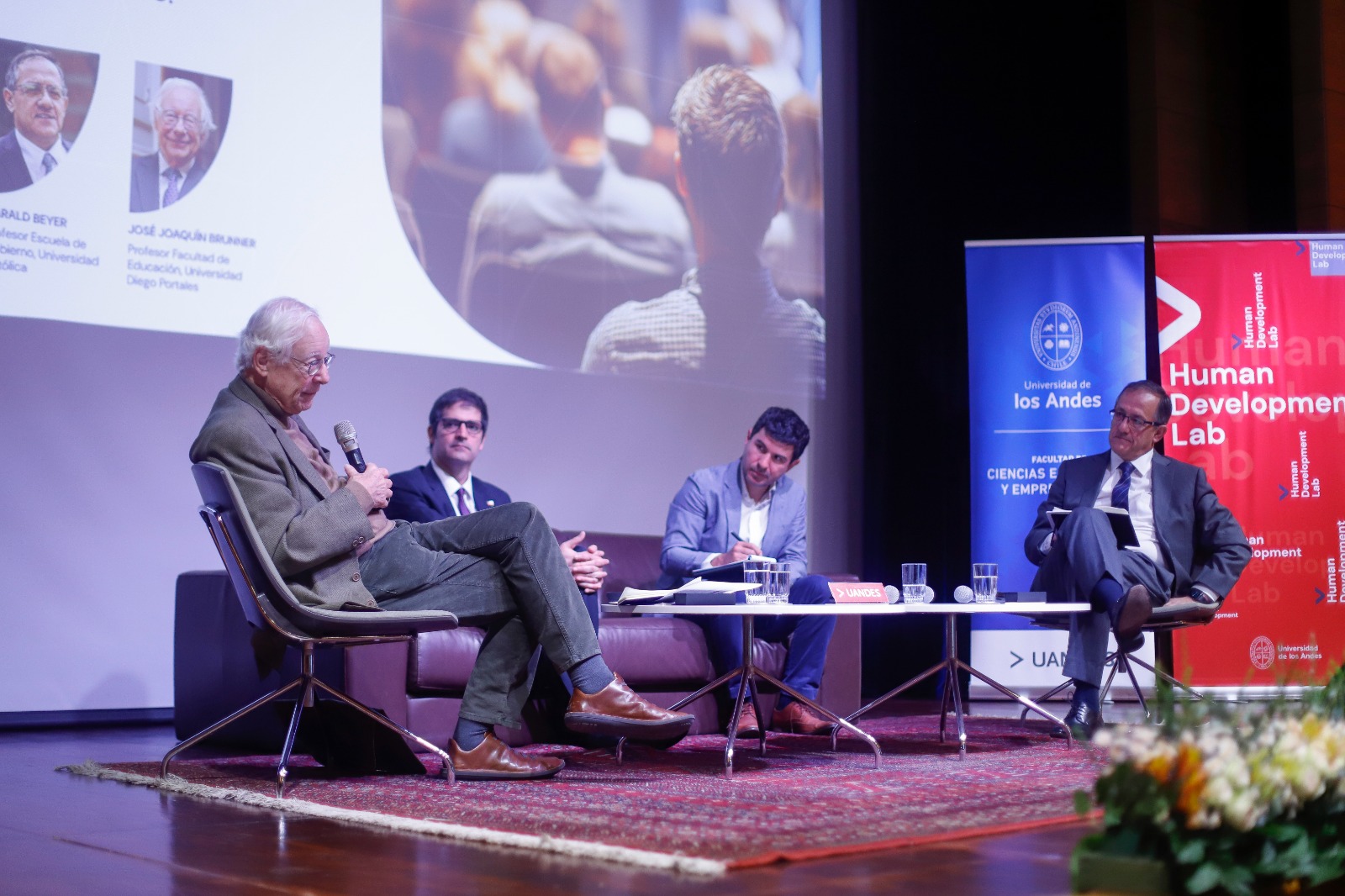
As part of the Chile in Construction: Debates for the Future series, the Human Development Lab hosted the panel “Educational Challenges and Urgencies for a Modern Chile”, bringing together policymakers and leading education experts to discuss the current state of Chile’s education system and the reforms needed to address its most pressing issues.
The discussion featured Chile’s Undersecretary of Education, Daniel Rodríguez, alongside academics Harald Beyer and José Joaquín Brunner. Throughout the conversation, panelists highlighted concerns about declining attendance, learning gaps, school violence, and the long-term impact of social and technological change on education.
Opening the discussion, Rodríguez described the situation as a sustained and multidimensional crisis. He noted that absenteeism remains one of the system’s greatest challenges, with 43% of students classified as chronically absent in 2025 — a figure that has yet to recover to pre-pandemic levels.
Learning outcomes were also a central concern. Rodríguez pointed out that only one in four fourth-grade students currently achieves adequate levels in mathematics, reflecting little improvement over the past decade. He also warned about the deterioration of school climate and coexistence, explaining that reports related to school violence have doubled over the last twelve years.
According to the Undersecretary, schools often lack the institutional tools needed to respond effectively to these situations. He emphasized the importance of strengthening the authority of teachers and school leaders, while advancing legislation focused on school coexistence and violence prevention.
The conversation also addressed structural challenges in public policy implementation. Rodríguez referred to ongoing difficulties within Chile’s Local Public Education Services (SLEPs) and questioned aspects of the school admission system, particularly in high-demand contexts where most applicants are assigned through random selection processes.
From an academic perspective, Harald Beyer argued that the education system is failing to guarantee minimum learning standards. He stressed that more than half of fourth-grade students are unable to read fluently, despite the level of resources invested in education.
Beyer also connected educational outcomes to broader issues of school environment and student wellbeing. He noted that Chile ranks among the countries with the lowest levels of school belonging and safety among 15-year-old students, factors that directly affect learning. In addition, he warned about the reemergence of gender gaps in mathematics performance.
Higher education was another focus of the discussion. Beyer questioned current admission and funding mechanisms, arguing that many students enter tertiary education without the academic preparation required to succeed, which contributes to dropout rates and places additional pressure on public spending.
Meanwhile, José Joaquín Brunner framed the educational crisis within a broader context of social fragmentation and institutional weakening. He argued that schools increasingly absorb responsibilities once shared by families and other social institutions, particularly regarding socialization and authority formation.
Brunner also reflected on how technological transformation — especially the expansion of artificial intelligence — is reshaping traditional assumptions about learning. In his view, education systems will need to rethink rigid structures and timelines as access to knowledge and learning processes continue to evolve.
The event was part of the Human Development Lab’s ongoing efforts to promote evidence-based discussions on the future of education, public policy, and social development in Chile.


