
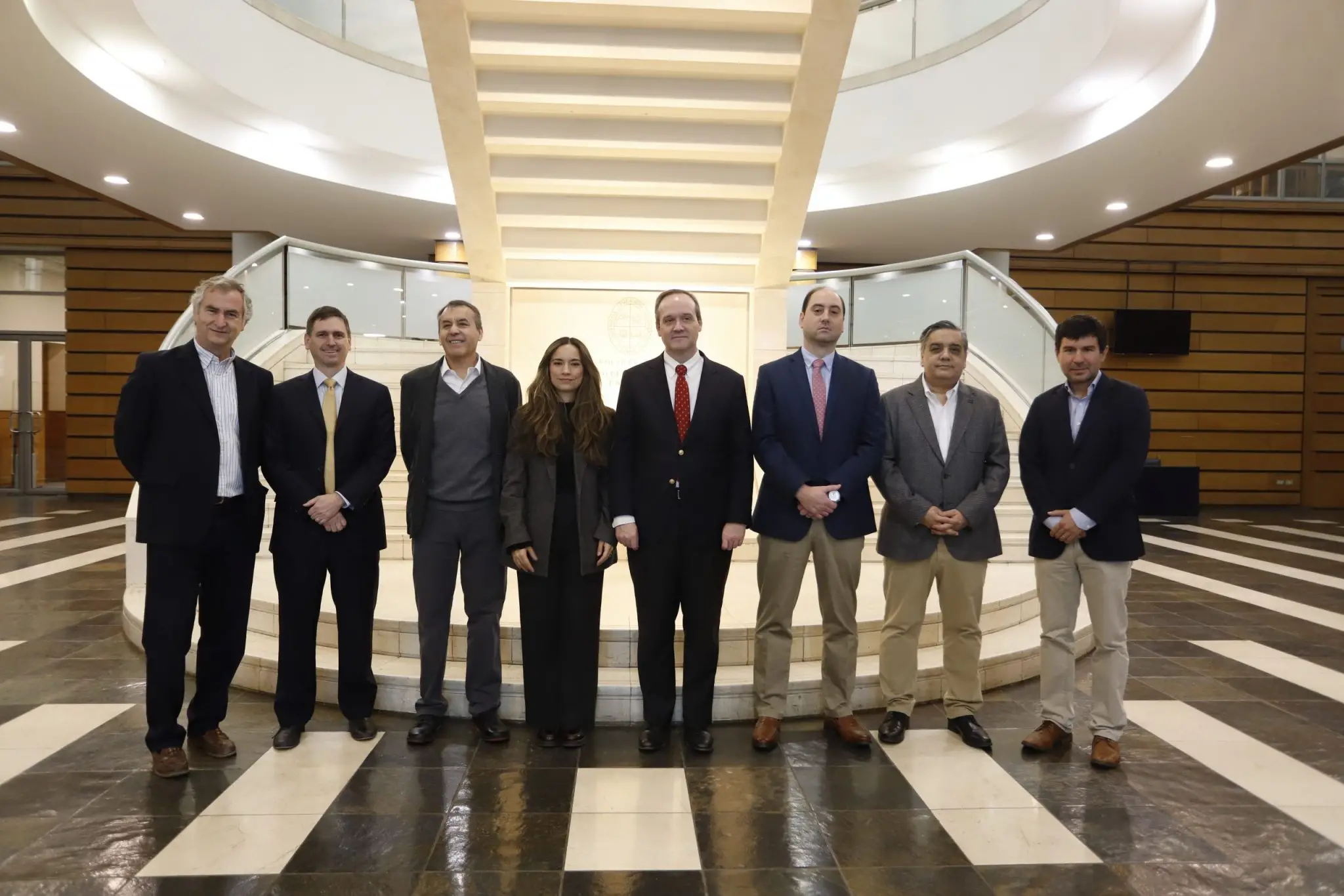
During the second panel of the series Chile in Construction: Debates for the Future, experts highlighted the need for broad agreements to restore dynamism to Chile’s labor market.
With unemployment rates remaining at historically high levels, persistent labor informality, and growing productivity challenges, experts from academia, the business sector, and public policy gathered to discuss the present and future of employment in Chile during the second panel of Chile in Construction: Debates for the Future. The event was organized by the Human Development Lab and brought together the School of Economics and Business, the School of Engineering and Applied Sciences, and the Advanced Center for Transport, Logistics and Economic Competitiveness.
The panel featured David Bravo, Dante Contreras, Rodrigo Mujica, and Luciano Cruz-Coke, who discussed the key challenges involved in revitalizing Chile’s labor market.
One of the most striking assessments came from David Bravo, who argued that Chile has yet to fully recover from the labor-market consequences of the COVID-19 pandemic. “We have not returned to normal,” he stated, noting that current unemployment levels remain comparable to those observed in the aftermath of the 2008 Global Financial Crisis.
Bravo described the country’s situation as a “labor market emergency” that has not been addressed with sufficient urgency. He also highlighted the persistence of structural challenges, particularly labor informality. According to his analysis, the share of workers without pension contributions remains similar to levels recorded in the 1990s, despite significant increases in educational attainment. “It is as if part of these educational gains are not translating into better labor-market skills,” he remarked.
Female labor-force participation was another central topic of discussion. Dante Contreras emphasized that one of Chile’s greatest opportunities for growth lies in enabling more women to enter and remain in the labor market. Drawing on evidence from Chile’s National Productivity Commission, he argued that advancing gender equality in employment could generate substantial economic and social benefits.
In this context, Contreras suggested that policies such as universal childcare should be viewed as investments with significant long-term returns for the country. He also questioned the effectiveness of current workforce training programs, noting that multiple evaluations have found limited impacts on both employment creation and wage growth.
From the business sector’s perspective, Rodrigo Mujica argued that Chile’s labor market has experienced a prolonged period of stagnation, with unemployment remaining above 8 percent for more than 40 consecutive months and employment levels yet to fully recover from the losses experienced during the pandemic.
Mujica stressed that economic growth will be critical to reversing this trend. He suggested that reducing the tax burden could encourage investment, create new jobs, and improve wages. In his view, Chile will need to increase its growth rate to offset the effects of recent labor reforms and prevent further deterioration in employment outcomes over the coming decade.
Luciano Cruz-Coke focused on the impact of public policies on the labor market and called for greater attention to their long-term effects. The senator argued that reforms such as the reduction of the workweek to 40 hours, increases in the minimum wage, and pension reform responded to important social demands, but have also introduced additional costs for businesses.
“Today there is a broader consensus around the need to promote growth and strengthen the labor market,” he said. In this regard, he emphasized the importance of reaching agreements that balance social rights, job creation, and economic competitiveness.
Despite their differing perspectives, the panelists agreed that Chile faces urgent challenges related to employment, productivity, and human capital development. They also stressed that addressing these issues will be essential for navigating the technological and economic transformations that are expected to reshape the labor market in the years ahead.


