
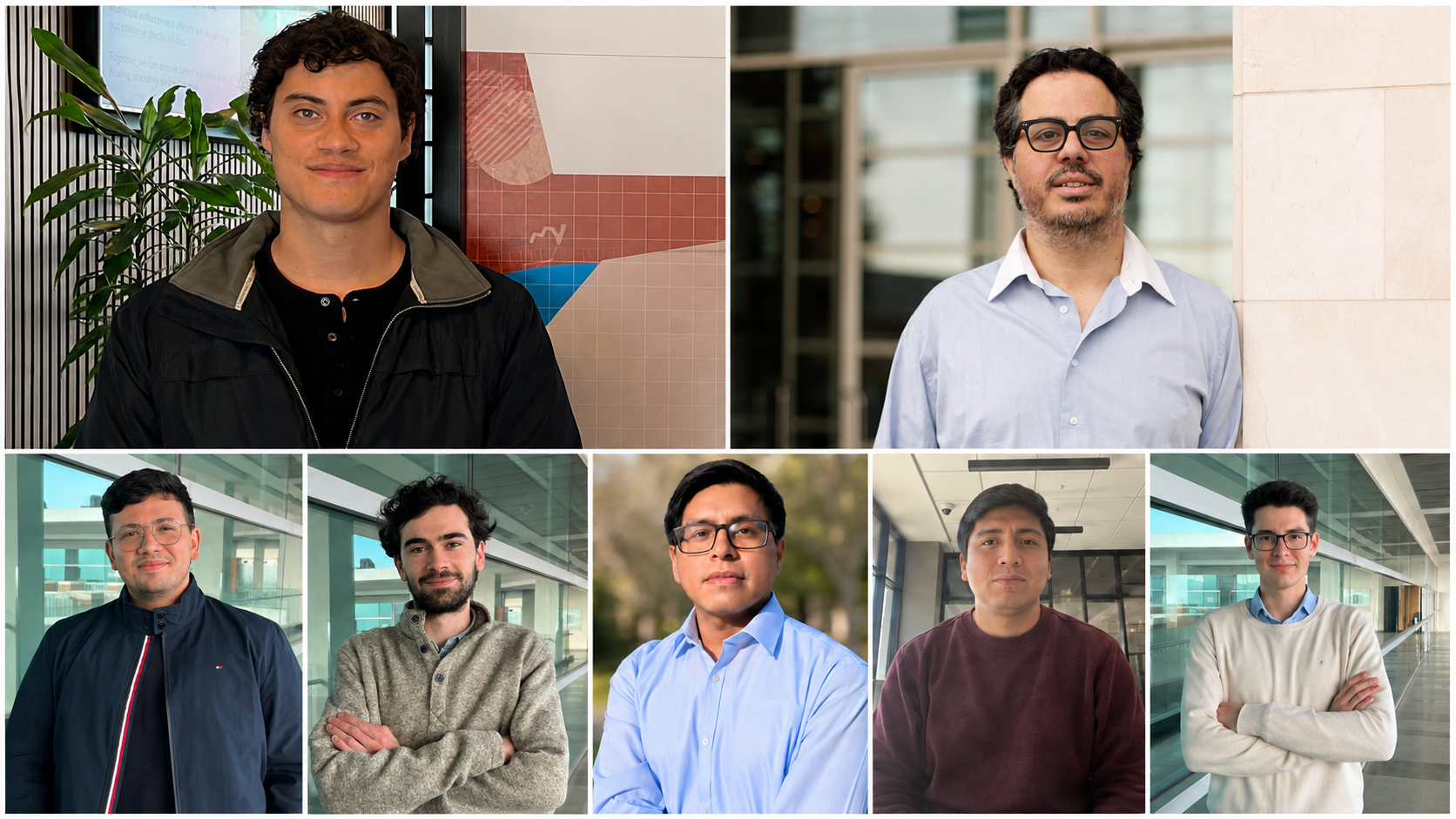
The Human Development Lab at Universidad de los Andes is pleased to announce several additions to its team, strengthening its research community across education, technology, labor economics, health, and public policy. The Lab welcomes Matías Recabarren as a new Research Associate, Javier Vasquez as a Postdoctoral Researcher, and José Ignacio Godoy, Fredy Joel Gonzales, Francisco Nova, Diego Quispe, and Benjamín Strobl as Junior Fellows.
At the same time, Cecilia Correa, Sofía Flechtner, Sofía Schuster, and Josefina Vilaplana move into the Human Development Lab alumni community as they begin new academic and professional stages.
Matías Recabarren Bahamondes joins the Human Development Lab as a Research Associate. He is an Associate Professor at the School of Engineering and Applied Sciences at Universidad de los Andes. Recabarren holds a degree in Computer Engineering and a PhD in Engineering Sciences, both from Pontificia Universidad Católica de Chile.
His research focuses on the intersection of technology and education, including engineering education, human-computer interaction, learning analytics, educational technologies, and STEM education. His incorporation strengthens the Lab’s interdisciplinary work on education and learning.
The Lab also welcomes Javier Vasquez Cubillos as a Postdoctoral Researcher. Vasquez completed his doctoral training in Economics through Universidad de Chile and the University of Groningen.
His research is in applied microeconomics, with a focus on causal inference, labor economics, and health. His recent work examines how health shocks, particularly the onset of disability, affect employment and earnings trajectories. His research complements the Lab’s work on human development and public-policy evaluation.
The Human Development Lab also welcomes José Ignacio Godoy, Fredy Joel Gonzales, Francisco Nova, Diego Quispe, and Benjamín Strobl as new Junior Fellows. All five currently work as Research Assistants at the School of Business and Economics at Universidad de los Andes.
José Ignacio Godoy studied Business and Economics with a major in Economics at Universidad de los Andes and subsequently pursued a Master’s degree in Economics at the same university. His research focus on education economy.
Fredy Joel Gonzales studied Economics at Pontificia Universidad Católica del Perú, where he also completed a Master’s degree in Economics. His previous research has included work on human capital, political violence, climate shocks, and development.
Francisco Nova studied Economics at Universidad de Chile and pursued a Master’s in Economic Analysis at the same university. His research interests include labor economics, the economics of education, and demography.
Diego Quispe studied Economics at Pontificia Universidad Católica del Perú, where he also completed a Master’s degree in Economics. He is currently pursuing a Master’s degree in Economics at Pontificia Universidad Católica de Chile. His research interests include labor economics, health economics, and public-policy evaluation.
Benjamín Strobl studied Business and Economics with a major in Economics at Universidad de los Andes and completed a Master’s degree in Economics at the same university. His research focus on education economy.
Together, the new Junior Fellows will contribute to the Lab’s ongoing research projects while continuing to develop their training and experience in applied economic research.
The transition also marks the beginning of new stages for four former Junior Fellows, who now join the Human Development Lab alumni community.
Cecilia Correa has moved to the Netherlands to pursue a PhD at Tilburg University.
Sofía Flechtner has joined the Ministry of Economy of the Government of Chile.
Sofía Schuster has joined the Central Bank of Chile.
Josefina Vilaplana, has joined the Ministry of Education of the Government of Chile.
These additions and transitions reflect the Human Development Lab’s role both as a center for interdisciplinary research on human development and as a space for the training of young researchers who go on to contribute to academia, public policy, and research institutions.


