
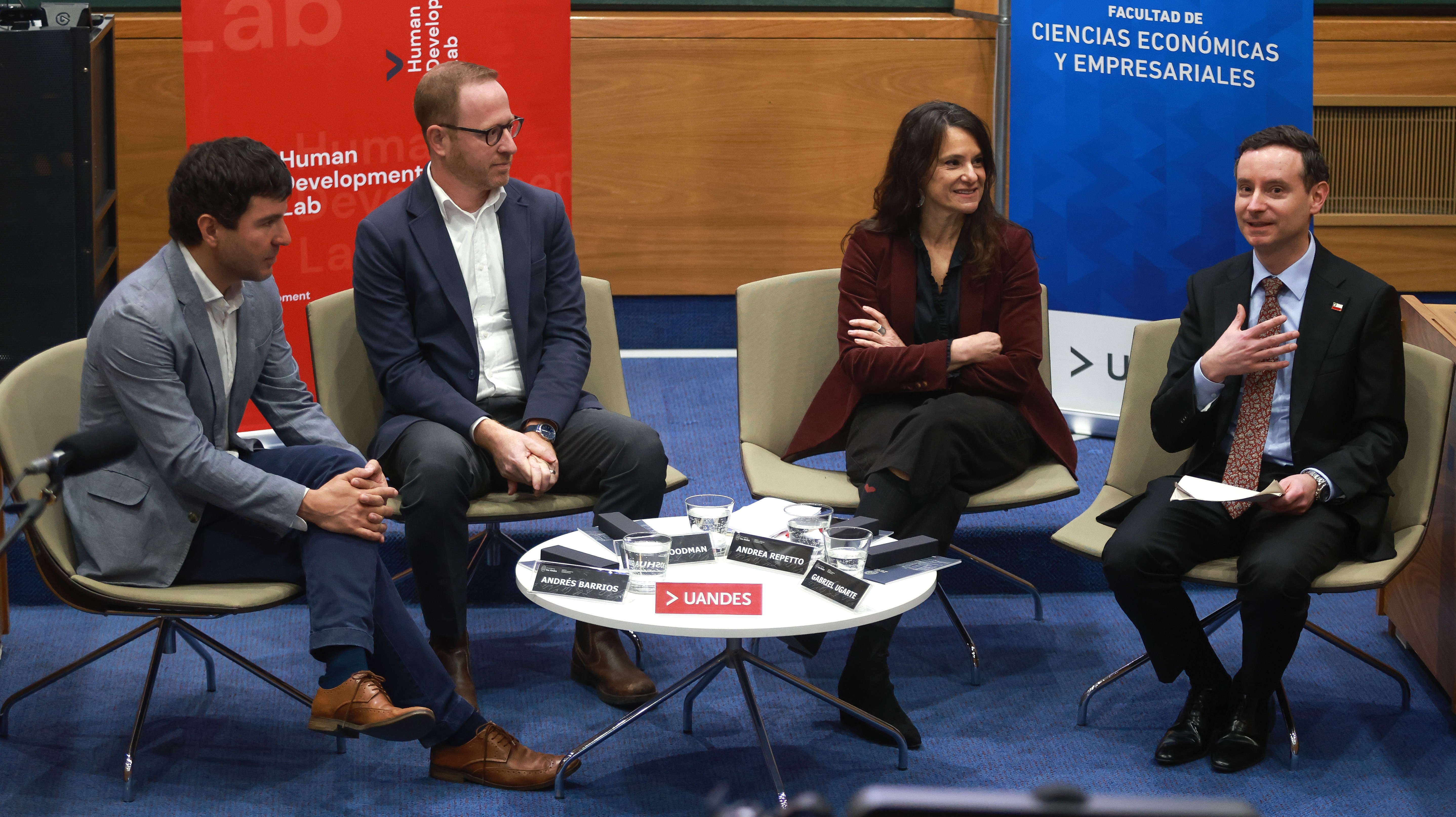
The Human Development Lab at Universidad de los Andes successfully hosted a new Policy Panel on August 18 as part of the series “Chile en Construcción: Debates para el Futuro.” The session, titled “Academia y políticas públicas: ¿cómo aportar e incidir desde la universidad?”, brought together Joshua Goodman, Andrea Repetto, and Gabriel Ugarte to discuss a central challenge for researchers and policymakers: how to ensure that rigorous academic research ultimately contributes to concrete public-policy decisions.
Moderated by Andrés Barrios, Director of the Human Development Lab, the conversation combined perspectives from academia and government and addressed some of the main barriers that can prevent research from influencing policy, including how evidence is communicated, the different timelines of academic research and government decision-making, and the complexity of translating research findings into action.
Joshua Goodman, Professor of Education and Economics at Boston University and former Senior Economist at the White House Council of Economic Advisers, drew on his experience in both academia and government to emphasize that producing rigorous research is only part of the challenge. Researchers must also be able to communicate their findings clearly and make them accessible to policymakers who often have limited time to engage with academic work.
Goodman highlighted the importance of complementing academic papers with shorter and more accessible formats, as well as building relationships with policymakers, advocates, and other actors who can help bring research into the policy conversation.
From the perspective of government, Gabriel Ugarte, Chile’s Undersecretary of Social Evaluation, highlighted another important challenge: the different timelines under which researchers and policymakers operate. While academic research can take several years, governments often need timely answers about whether programs are working, who they are reaching, and how public resources can be used more effectively.
Ugarte also discussed efforts to strengthen the use of evidence within the Chilean State, including the opening of administrative information to researchers through the Registro de Información Social (RIS) and the monitoring and evaluation of public programs. He encouraged researchers to use these tools to develop applied research agendas around major challenges facing Chile.
Andrea Repetto, Professor and Director of the School of Government at Pontificia Universidad Católica de Chile, added another dimension to the discussion by cautioning against treating “the evidence” as if it necessarily provided a single answer. Different studies can reach different conclusions, she argued, making it important to consider the broader body of available research as well as institutional, social, and other dimensions that may not be fully captured by economic analysis alone.
The discussion ultimately highlighted that the connection between academia and public policy depends on more than producing high-quality research. Evidence must also be communicated effectively, made available at the right time, interpreted carefully, and connected with the institutions and people responsible for turning research into policy.
Through its Policy Panel series, the Human Development Lab seeks to strengthen this connection by creating spaces where researchers, policymakers, and public-sector leaders can exchange perspectives on how academic research can contribute to addressing Chile’s main public-policy challenges.
You can watch the full Policy Panel below.


