
Para la versión en español de este reporte, revise acá.
Chile’s performance declined in reading and mathematics, while remaining stable in science. The fall, however, comes amid a broader international deterioration in learning outcomes and with still significant gaps relative to the OECD.
The new PISA 2025 results, released this Tuesday by the OECD, show that Chilean students scored 436 points in reading, 403 in mathematics, and 442 in science. Compared with 2022, Chile fell by 12 points in reading and 9 points in mathematics, while science performance remained statistically stable.
The historical trajectory shows that the gains recorded by Chile during the earlier PISA cycles were reversed, giving way to a downward trend that has persisted over the past decade (see Figure 1). The deterioration is particularly visible in reading and mathematics, while science has followed a more stable trajectory.
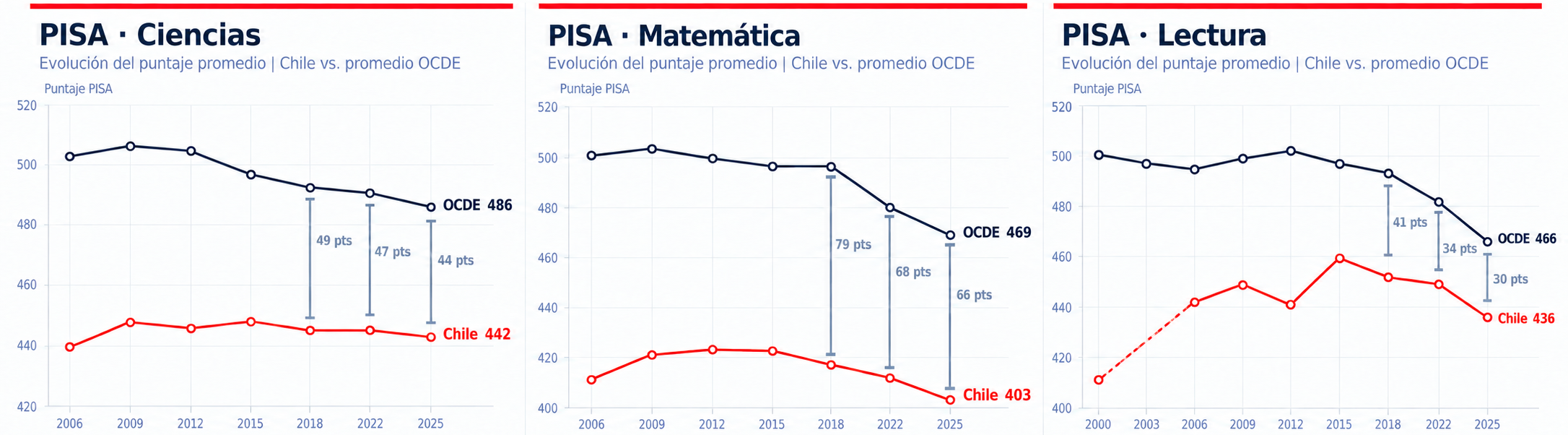
The decline, however, is far from being exclusively Chilean. Among the 74 systems with comparable data between 2022 and 2025, 42 declined in reading and 38 in mathematics. The OECD average fell by 14 and 9 points, respectively. In science, by contrast, 48 systems remained statistically stable.
The deterioration is, in fact, a global phenomenon: despite its own declines, Chile has gradually narrowed some of its gaps with the OECD, whose performance has also weakened. This comparative perspective is key to interpreting the results and thinking about how to reverse the trend.
Andrés Barrios, Director of the HDL: “The decline experienced by Chile is not an isolated phenomenon. A large share of the countries participating in PISA experienced similar declines. It is important to take this into account when developing a diagnosis and proposing measures to reverse the trend. There are two phenomena that I believe are worth examining carefully: the pandemic and the increase in the use of screens and social media.”
Andrés Barrios points to two different mechanisms. On the one hand, the pandemic may have left cumulative effects on learning trajectories, particularly when content that was not recovered affects subsequent learning. On the other, the increase in the use of screens and social media raises questions about possible changes in attention, study habits, and the time devoted to reading. How much each factor explains the observed deterioration remains an open question.
In Chile, this diagnosis is compounded by a more immediate challenge: ensuring that students are actually in the classroom. For Isabela Munevar, Associate Researcher at the Human Development Lab, recovering school attendance is a necessary condition for any strategy aimed at improving learning.
Isabela Munevar: “School attendance is a fundamental element in recovering learning. Severe absenteeism increased from 19% in 2018 to 28% today, and the OECD estimates that a student with prolonged absences loses around 50 PISA mathematics points. Without students in the classroom, no pedagogical policy can work.”
Chile remains among the highest-performing education systems in Latin America, but its advantage has narrowed. In reading, it continues to have the highest score in the region. In mathematics and science, Uruguay records similar average results, with both countries currently leading Latin America (see Figure 2).
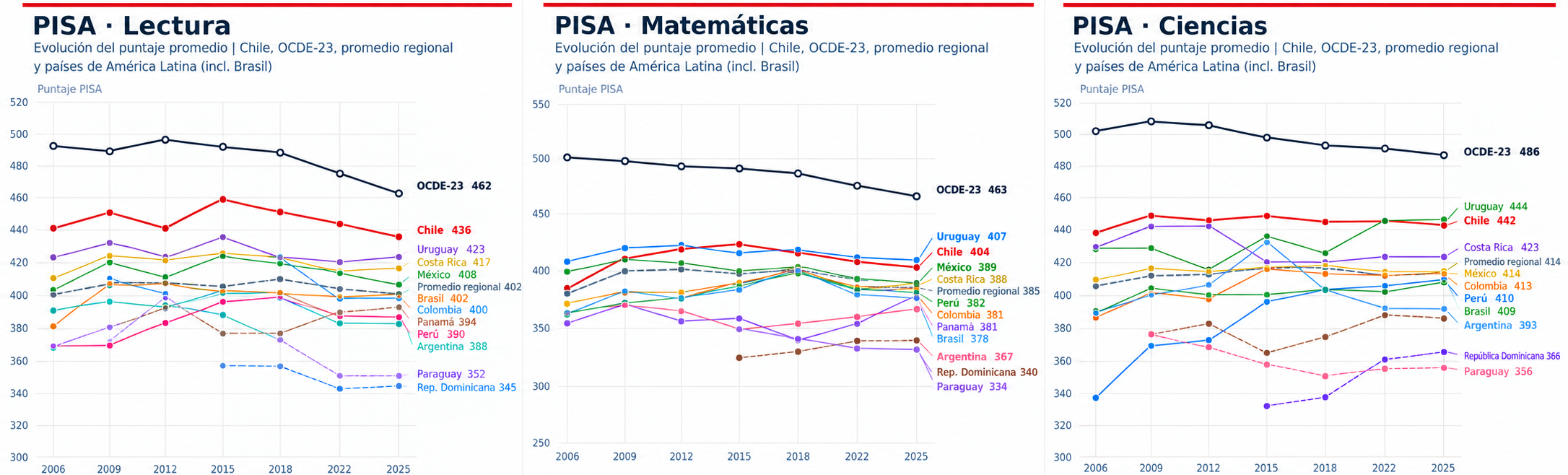
In a predominantly adverse regional environment, Costa Rica represents a particularly interesting case for Chile: between 2022 and 2025, it improved by 13 points in science, while reading and mathematics remained stable. Given its regional proximity and a level of development that is more comparable to Chile’s, its experience offers a closer reference point for studying which policies may help contain or reverse the deterioration in learning outcomes.
Looking at these results from another perspective, while also considering countries’ level of development—measured by GDP per capita—provides an additional benchmark for interpreting the gaps. This comparison helps distinguish how much of a country’s relative performance may be associated with differences in resources and levels of development, and how much appears to deviate from what might be expected given that context.
A clear relationship emerges from this exercise: higher-income countries tend to achieve better PISA results. Within this relationship, Chile performs somewhat above what would be expected in reading and science, and slightly below expectations in mathematics (see Figure 3).
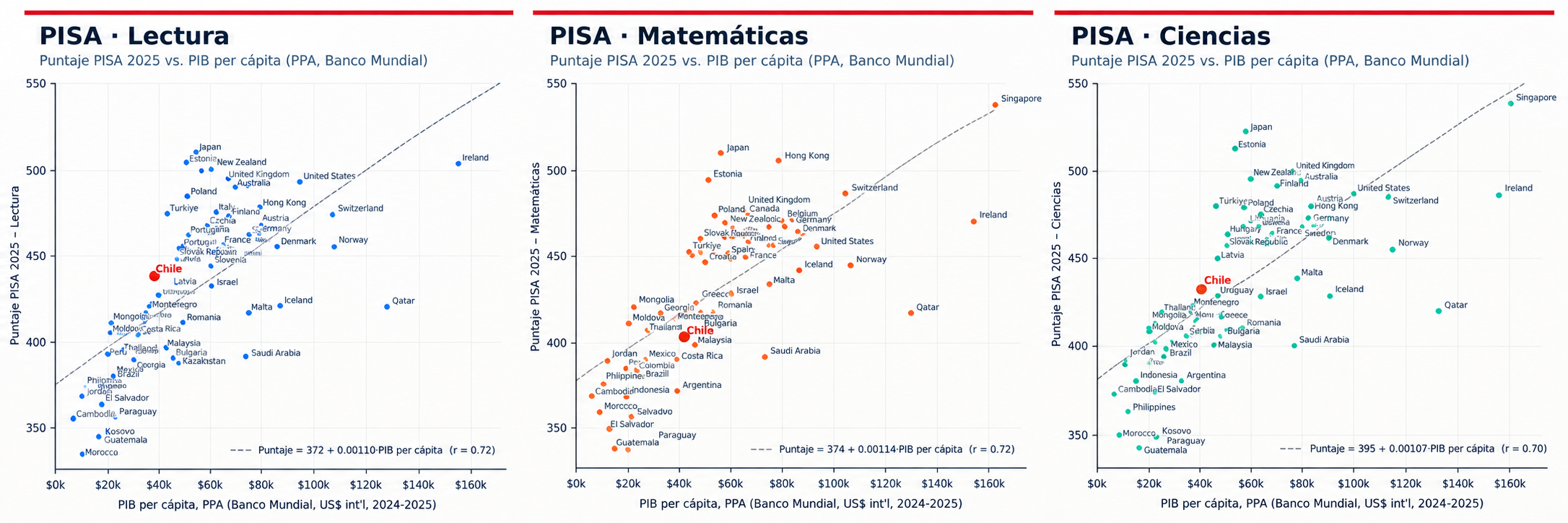
Andrés Barrios: “Chile’s results are aligned with its level of development. In fact, in reading and science, the country performs somewhat better than we would expect given its income level. The differences we observe relative to richer countries suggest that closing these gaps will also require a return to economic growth, in order to generate additional resources that can strengthen our school system.”
The comparison therefore suggests that closing the education gap is also linked to the challenge of restoring economic growth. This interpretation requires caution, however: the figure shows an association and does not necessarily imply a causal relationship.
The OECD reported that the response rate among Chilean students did not fully meet PISA’s initial standard. The organization conducted additional analyses of potential biases and concluded that the data were suitable for publication. The warning therefore does not invalidate the results, but it reinforces the importance of ensuring high levels of participation in future assessments.
Andrés Barrios: “To design good public policies, we need reliable and comparable measurements. Chile must make every necessary effort to ensure high participation rates in assessments such as PISA.”
In reading, Chile fell from 448 points in 2022 to 436 in 2025. Moreover, only 62% of students reached at least the basic level of reading proficiency, compared with an OECD average of 69%, meaning that almost four out of every ten Chilean 15-year-olds do not reach this threshold.
For Pelusa Orellana, researcher at the Human Development Lab and a specialist in reading, part of the discussion should consider changes in reading habits.
Pelusa Orellana: “Reading is a multifactorial and complex process, and for that reason there are no quick solutions. One factor that may contribute to this global decline is the reduction in reading volume. The more time we spend on screens, the less time remains for deep and meaningful reading.”
In line with Andrés Barrios’ concern about the increased use of screens and social media, Orellana focuses on a specific mechanism: the possible substitution of reading time by screen exposure. This may reduce not only how much students read, but also their opportunities to engage in longer, more focused, and deeper reading.
Another point raised by Orellana connects directly with the challenge of having greater resources available. Improving opportunities for reading also requires ensuring concrete conditions for it to take place: access to books, appropriate spaces, and time specifically devoted to reading, particularly in contexts where these opportunities are more limited.
Pelusa Orellana: “We need public policies that guarantee access to books and opportunities for reading, especially in places that are farther away from libraries. Access to books is a fundamental condition for reading to spread and develop.”


