
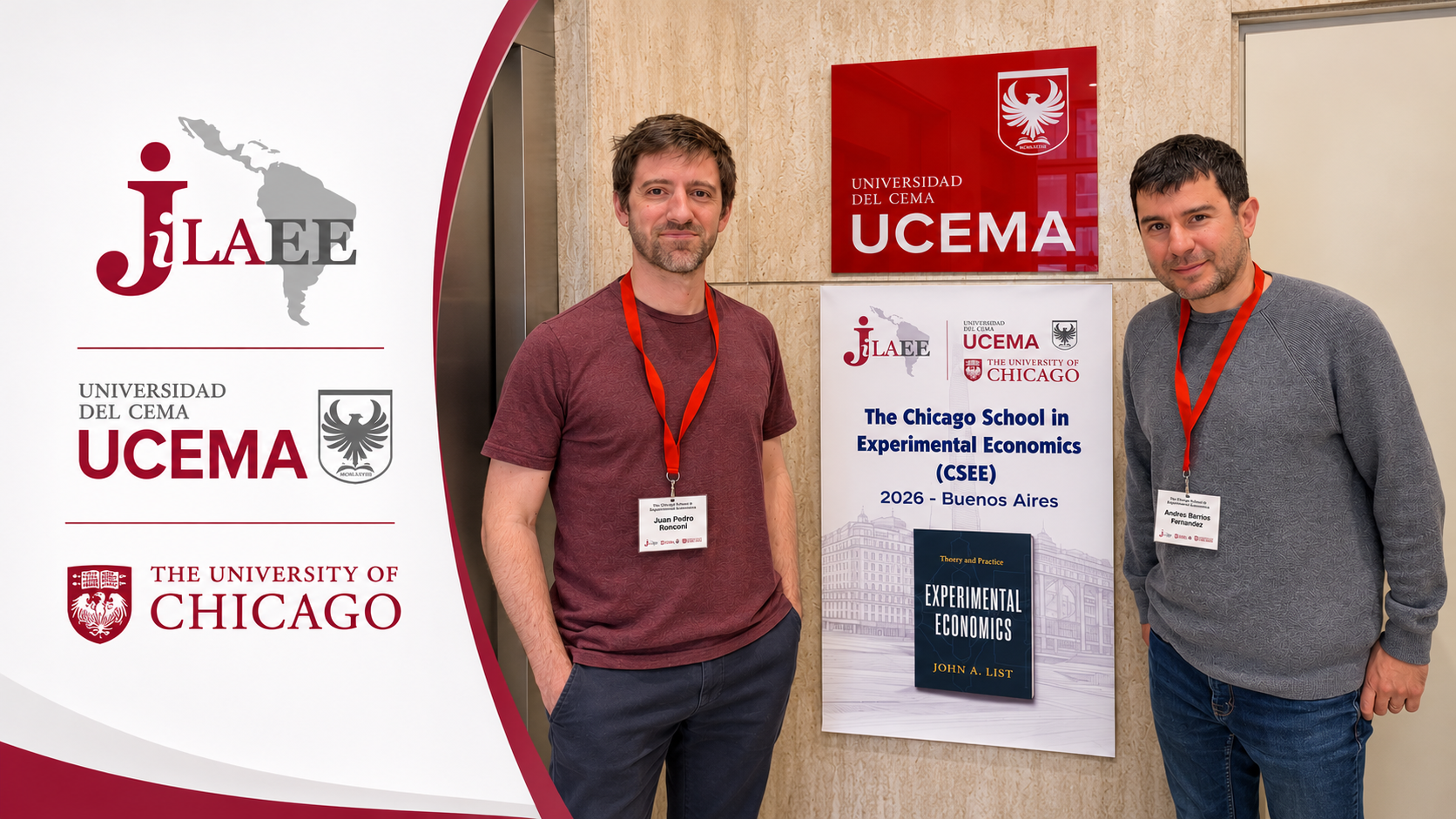
Andrés Barrios, Director of the Human Development Lab, and Juan Pedro Ronconi, researcher at the Lab, participated in the Chicago School in Experimental Economics (CSEE), held from November 4 to 8, 2026, at Universidad del CEMA in Buenos Aires, Argentina.
Organized by the University of Chicago, Universidad del CEMA, and the Joint Initiative for Latin American Experimental Economics (JILAEE), the school brought together scholars interested in advancing their knowledge of experimental methods in economics. The program was funded by Universidad del CEMA and the Gracias Center for Human Sciences and Well-being.
The program featured an intensive course led by John List, professor at the University of Chicago and a leading figure in experimental economics, together with lecturers from institutions such as UC San Diego, the University of Michigan, and Erasmus University Rotterdam. Sessions covered the full experimental research process, from the design and implementation of experiments to their analysis and interpretation, and participants had the opportunity to discuss their own research projects.
The curriculum was based on List’s new textbook, Experimental Economics: Theory and Practice (University of Chicago Press), a comprehensive guide to experimental methods that pays special attention to a key challenge for public policy: how to ensure that results observed in small pilots hold when programs are scaled up.
The Joint Initiative for Latin American Experimental Economics (JILAEE) is a research initiative founded by John List and Julio Elías that brings together researchers, public and private institutions, and social innovators. Its mission is to inspire positive social change through innovative research in Latin America, partnering with institutions to generate rigorous evidence and supporting researchers who run field experiments in the region. Its work spans areas such as early-childhood education, the financial sector, and institutions and governance.
Experimental methods are central to much of the Human Development Lab’s research agenda. HDL researchers have used randomized evaluations to study, among other topics, how mentoring and information programs affect students’ access to higher education and how behavioral interventions can improve planning and performance in small firms.
The participation of Barrios and Ronconi reflects the Human Development Lab’s commitment to rigorous empirical research and continued engagement with the international academic community. The tools and discussions from the school will feed into the Lab’s ongoing and future experimental projects in education and human development.


