
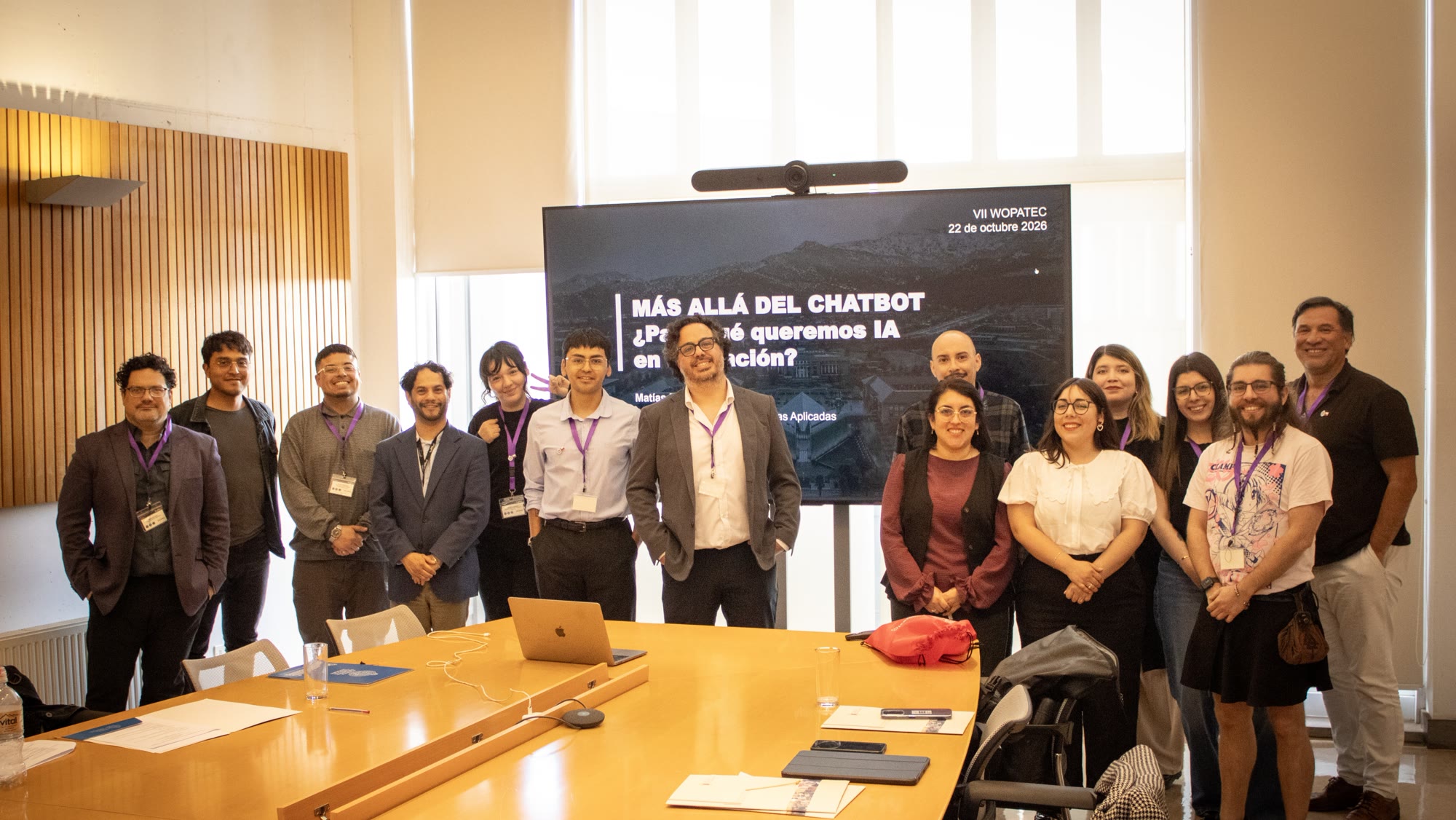
Human Development Lab Research Associate Matías Recabarren gave the keynote lecture at the VII Workshop on Automated Text and Corpus Processing (WoPATeC), held on October 22 under the theme “Thinking Education with Generative Artificial Intelligence.” His talk, “Beyond the Chatbot: What Do We Want AI in Education For?”, addressed one of the most pressing questions facing education systems today.
The workshop took place at the Viña del Mar campus of Universidad Adolfo Ibáñez in a hybrid format. It was organized in collaboration with the Pontificia Universidad Católica de Valparaíso (PUCV), coordinated by René Venegas and Constanza Cerda-Canales of the PUCV Institute of Literature and Language Sciences, and was part of the VI PRISMA International Congress, held from October 21 to 23.
WoPATeC is a forum for scientific and technological research on the development and use of computational tools in and for Spanish, with a particular focus on generative artificial intelligence and natural language processing in educational contexts. This year’s edition brought together work from linguistics, engineering, education, and the social sciences.
The program was organized into four sessions of presentations, covering topics such as automated language analysis, feedback on academic writing using language models, and the social imaginaries and public discourse surrounding artificial intelligence.
The keynote lecture by Matías Recabarren, Associate Professor at the School of Engineering and Applied Sciences of Universidad de los Andes and Research Associate at the Human Development Lab, posed a question that goes beyond the tools themselves: what do we actually want artificial intelligence to do in education?
As generative AI tools become part of everyday life for students and teachers, the discussion often centers on chatbots and on how to regulate or restrict their use. Recabarren’s lecture invited participants to look past this framing and to think about the purposes AI should serve in teaching and learning, and how it can contribute to education in ways that are pedagogically meaningful.
Recabarren’s research focuses on the intersection of technology and education, including engineering education, human–computer interaction, learning analytics, and educational technologies. At the HDL, he has worked on evaluating the use of AI in education, including a recent study with Carolina Melo and Javiera de la Maza on the reliability of large language models for classroom observation.
Artificial intelligence is rapidly changing how students learn, how teachers prepare and deliver their classes, and how schools and universities operate. Its potential impact on education is significant, from personalized support for students and new forms of feedback to tools that help teachers improve their practice. At the same time, it raises important questions about learning quality, equity, and the role of human judgment in education.
For the Human Development Lab, this makes rigorous research on AI in education a priority. Understanding when these technologies improve learning, for whom, and under what conditions is essential to ensure that their adoption is guided by evidence rather than enthusiasm alone. Recabarren’s participation in WoPATeC reflects the Lab’s commitment to contributing to this conversation and to building the evidence needed to make the most of AI’s potential in education.


