
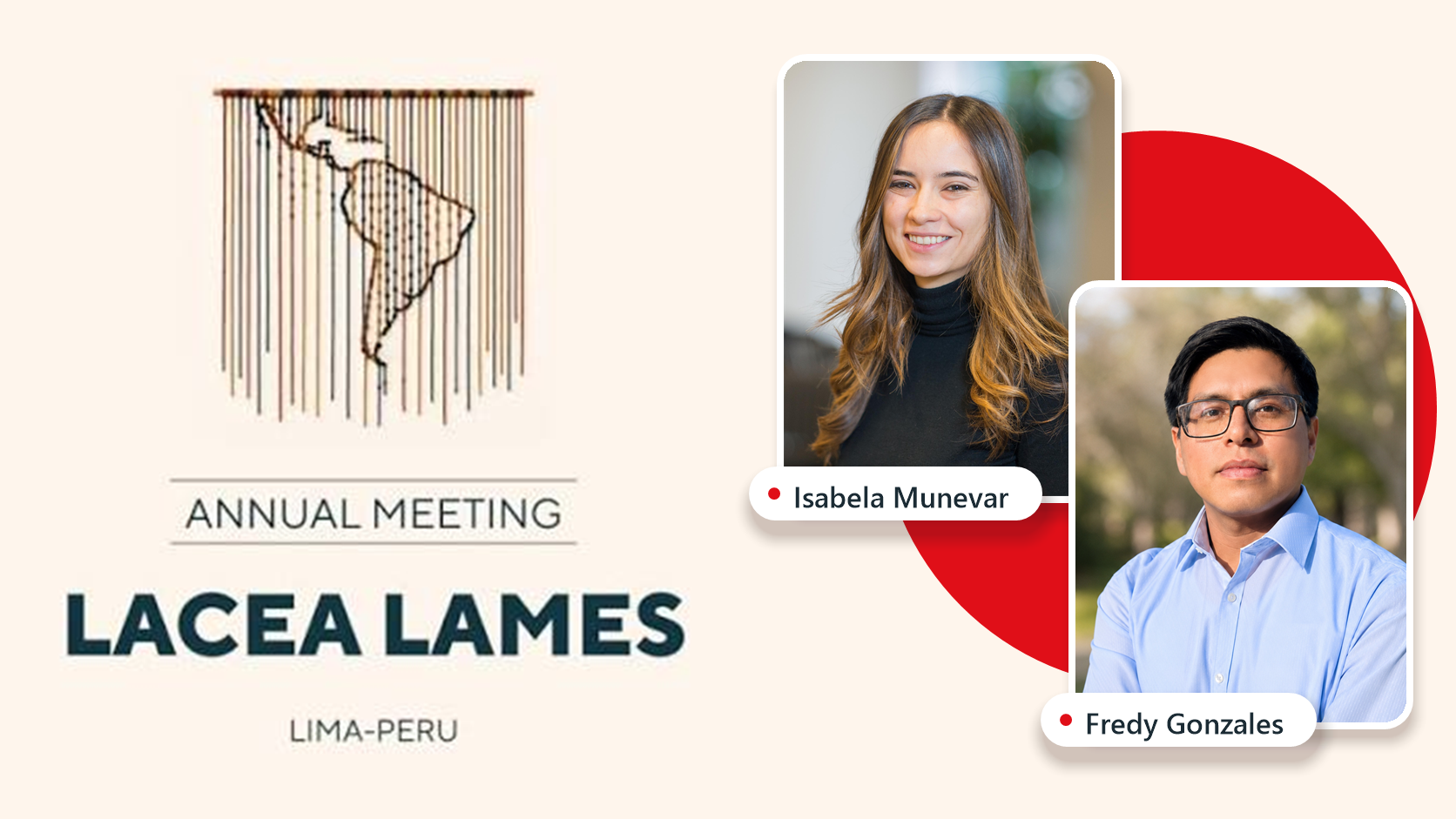
Isabela Munevar, Associate Researcher at the Human Development Lab, and Fredy Gonzales, Junior Fellow at the Lab, presented their research at the LACEA–LAMES 2026 Annual Meeting, held from November 12 to 14 at the Pontificia Universidad Católica del Perú (PUCP) in Lima, Peru.
The annual meeting brings together the Latin American and Caribbean Economic Association (LACEA) and the Latin American Meeting of the Econometric Society (LAMES), and is one of the most important gatherings for economic research in the region. This year’s program included keynote lectures by leading economists such as Iván Werning (MIT), Rema Hanna (Harvard Kennedy School), Erica Field (Duke), Eduardo Engel (Universidad de Chile), and Stéphane Bonhomme (University of Chicago), alongside a broad program of paper sessions across all fields of economics.
For the Human Development Lab, the meeting was also a sign of how its research network continues to grow. A year after Lab researchers took part in LACEA 2025 in Recife, this edition featured work from both a faculty member and one of the Lab’s new Junior Fellows, who presented two very different studies, on school finance and on environmental policy, before an international audience.
In the session School Resources, Families, and Student Outcomes, Isabela Munevar presented “Not All Dollars Are Equal: The Composition of School Spending and Student Outcomes,” joint work with Gregory Elacqua and María Fernanda Prada (Inter-American Development Bank) and Julio Rodríguez (University of Oxford).
The debate over school funding usually focuses on how much money schools receive. This study asks a different question: does it matter how schools spend their resources?
To answer it, the authors take advantage of a unique feature of the Chilean school system: every publicly funded school must submit audited, highly detailed financial accounts every year. The team assembled a national panel of urban schools for 2015–2022, classifying spending into six broad categories and 37 subcategories, from different types of personnel to pedagogical programs, operations, infrastructure, and student well-being. They then linked these accounts to measures of school value added, which capture each school’s contribution to its students’ progress, along four dimensions: test scores, attendance, chronic absenteeism, and dropout.
The results show that total spending per student is only weakly associated with school effectiveness. What matters is the composition of that spending, and no single category is associated with improvements across all four outcomes:
The study also finds important differences across schools. Spending on quality programs and student well-being, the categories prioritized by Chile’s targeted equity subsidy for disadvantaged students (Subvención Escolar Preferencial, SEP), is associated with higher test-score value added mainly in the most disadvantaged schools. Operations and infrastructure spending, in turn, show opposite associations in public and private voucher schools.
The authors note that these relationships are modest in size: a one-standard-deviation increase in the most predictive spending categories corresponds to 2 to 7 percent of the variation in value added across schools. Even so, the message for policy is clear. The composition of spending is more informative than spending levels alone, and evaluating school finance policies on a single outcome, or on average effects for all schools, can understate the benefits of targeted investments.
Fredy Gonzales presented “Cleaner Heating and Local Air Quality: Causal Evidence from Chile’s Heater Replacement Program” in the session Deforestation, Mining, and Air Quality.
In many cities of central and southern Chile, winter brings high levels of air pollution, and residential wood burning for heating is a leading source of fine particulate pollution. To address this problem, the Chilean government has implemented a Heater Replacement Program that replaces old wood-burning heaters with cleaner alternatives, such as pellet or kerosene heaters, as part of the decontamination plans of the most affected cities.
Gonzales’s study asks whether this policy delivers on its central promise: does replacing household heaters measurably improve the air that local residents breathe? Separating the effect of the program from other factors that shape air quality, such as weather or other environmental regulations, is a central challenge, and the paper is designed to provide causal evidence on the program’s impact on local air quality.
The question is highly relevant for public policy. Heater replacement involves substantial public investment, and rigorous evidence on its effects on local air quality is key to deciding how to design, target, and scale up this type of program.
Gonzales joined the Human Development Lab as a Junior Fellow in 2026. He studied Economics at the Pontificia Universidad Católica del Perú, where he also completed a Master’s degree in Economics, and his research has covered human capital, political violence, climate shocks, and development.
The participation of Munevar and Gonzales reflects the Human Development Lab’s commitment to rigorous empirical research and to building connections with the international academic community. Presenting at LACEA–LAMES allows the Lab’s researchers, from faculty to its newest Junior Fellows, to share their work, receive feedback from leading economists, and strengthen research collaborations across Latin America.


