
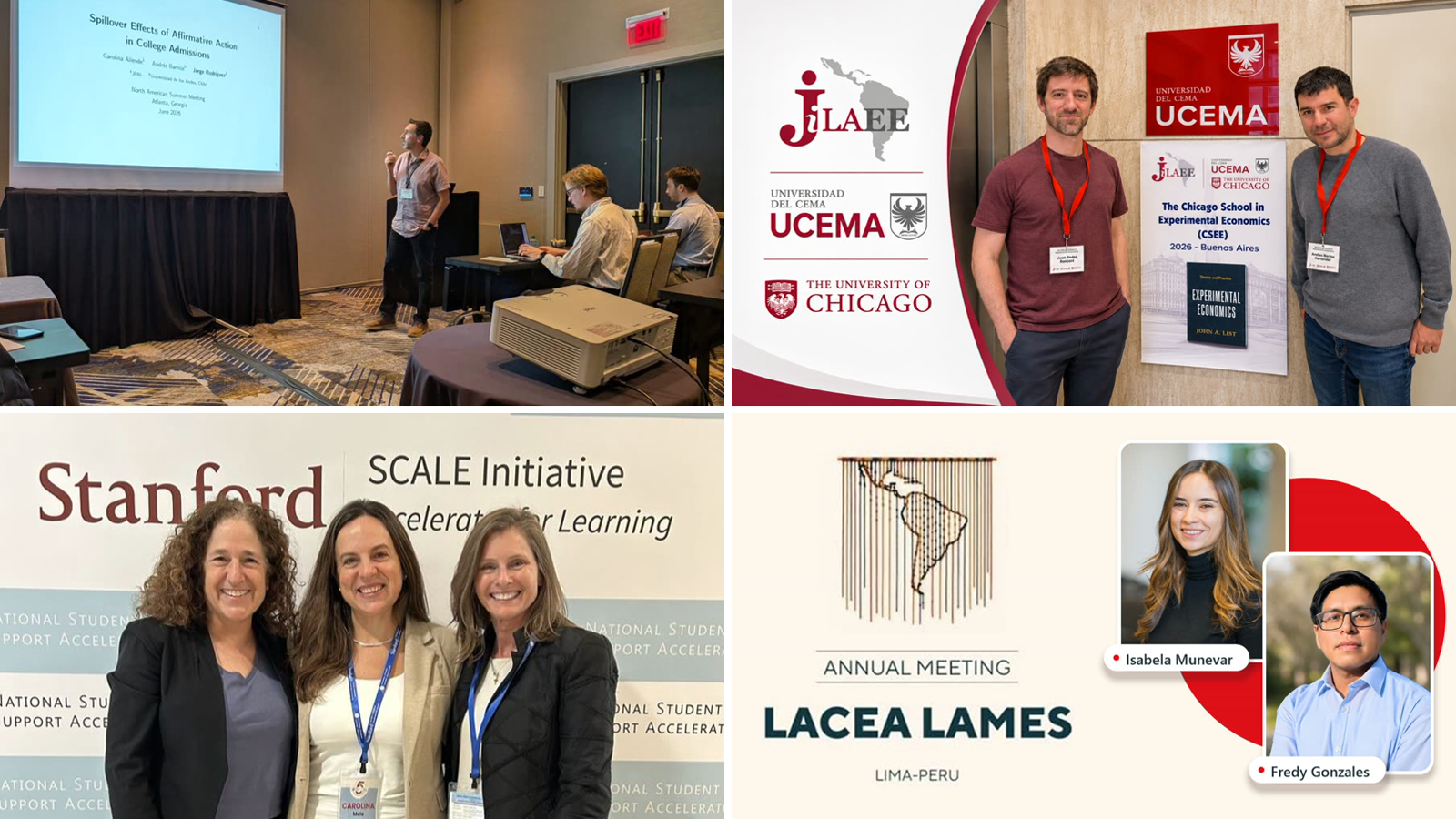
2026 was a landmark year for the Human Development Lab on the international stage. Our researchers took their work to ten conferences across the United States, Europe and Latin America, including some of the most prestigious venues in economics, such as the NBER Summer Institute, the ASSA Annual Meeting and the Econometric Society. From affirmative action and school spending to immigrant talent, high-impact tutoring and the intergenerational transmission of human capital, the Lab’s research reached the forums where the most important conversations in the field take place, and the year is not over yet.
Every one of these presentations reflects the Lab’s growing global presence: a team that publishes, debates and collaborates with leading scholars around the world, and that brings back to Chile new ideas, networks and evidence to inform public policy. The map below shows every stop of an extraordinary year. Hover over or tap each point to see what was presented there.
2026 conferences Upcoming · Hover over or tap a point to see what was presented
January 3–5, 2026 · Andrés Barrios
The year kicked off at the largest gathering of economists in the world. Andrés Barrios, Director of the Human Development Lab, took part in the annual meeting of the Allied Social Science Associations (ASSA), setting the tone for a year of strong international presence.
April 23–24, 2026 · Andrés Barrios
In April, Barrios joined the spring meeting of the National Bureau of Economic Research (NBER) Economics of Education Program at the University of Chicago’s Gleacher Center, one of the most selective forums for frontier research in the field.
May 28–30, 2026 · Francisco Morales
At the University of Colorado Boulder, Francisco Morales presented “A Unique Blend: How Immigrant Talent Combinations Affect Organizational Performance”, co-authored with Britta Glennon and Exequiel Hernandez (Wharton) and Seth Carnahan (Washington University in St. Louis). Drawing on three decades of European professional football, the study shows that organizations with more distinctive immigrant talent compositions outperform their competitors. Morales was also a member of the conference’s Scientific Committee, helping select the papers in the academic program.
June 2026 · Jorge Rodríguez
At one of the leading international meetings in economics, Jorge Rodríguez presented “Spillover Effects of Affirmative Action in College Admissions”, co-authored with Carolina Allende and Andrés Barrios. The study sheds new light on the broader effects of affirmative action policies, a key question for higher education and access to university.
June 2026 · Carolina Melo
Carolina Melo joined researchers, policymakers and practitioners at Stanford to discuss the future of high-impact tutoring at the conference of the National Student Support Accelerator. Her participation is part of an ongoing collaboration with Pelusa Orellana and Stanford scholar Susanna Loeb, supported by a Stanford International Research Exploration Seed Grant.
July 2026 · Andrés Barrios
In Spain, Barrios presented “Gender, Child Development, and the Intergenerational Transmission of Human Capital” at the summer program of the Universidad Internacional Menéndez Pelayo, sharing the Lab’s research on how human capital is passed on across generations with scholars from across Europe.
July 2026 · Andrés Barrios
One of the highlights of the year: Barrios was invited to the 50th edition of the NBER Summer Institute, widely regarded as one of the most prestigious research forums in economics, where participation is by invitation only.
July 22–23, 2026 · Fredy Gonzales and Diego Quispe
The Lab’s new generation also made its mark. Two of our Junior Fellows presented their research at the congress, held at Universidad del Pacífico: Fredy Gonzales presented “Revisiting the Long-Run Educational Effects of the Ancash Earthquake: A Comment on Caruso & Miller (2015)”, co-authored with César Huaroto, and Diego Quispe presented “The Silent Cut: Real Erosion of Frozen-Nominal Cash Transfers and Household Welfare in Peru.”
November 4–8, 2026 · Andrés Barrios and Juan Pedro Ronconi
Barrios and Juan Pedro Ronconi were part of an intensive week on experimental methods at Universidad del CEMA, led by John List (University of Chicago), one of the world’s leading figures in experimental economics, strengthening one of the methodological pillars of the Lab’s research.
November 12–14, 2026 · Isabela Munevar and Fredy Gonzales
At the most important gathering of economists in Latin America, held at the Pontificia Universidad Católica del Perú, the Lab presented two studies. Isabela Munevar presented “Not All Dollars Are Equal: The Composition of School Spending and Student Outcomes”, which shows that how schools spend their resources matters more than how much they spend, and Fredy Gonzales presented “Cleaner Heating and Local Air Quality: Causal Evidence from Chile’s Heater Replacement Program.”
And there is more to come. In the coming weeks, Andrés Barrios will take part in:


