

A study by Human Development Lab Research Associate Marcela Mello and João Garcia has received a Revise and Resubmit (R&R) decision from the American Economic Journal: Applied Economics. The research examines how the election of mayors affiliated with Pentecostal parties in Brazil affects school policies, teenage pregnancy, and girls’ educational trajectories.
The paper, “Religious Mayors, School Appointments, and Teenage Pregnancy,” studies what happens when religious political movements gain control over local governments with substantial discretion over public schools.
Using close mayoral elections in Brazil between 2008 and 2016, Mello and Garcia compare municipalities where candidates from two Pentecostal-linked parties narrowly won with municipalities where they narrowly lost. This regression discontinuity design allows the authors to identify the causal effects of these electoral victories among closely contested municipalities.
The results point to an important role for the school system. In Brazil, municipal mayors have considerable authority over municipal schools, including the appointment of school principals and the implementation of non-mandatory curriculum components.
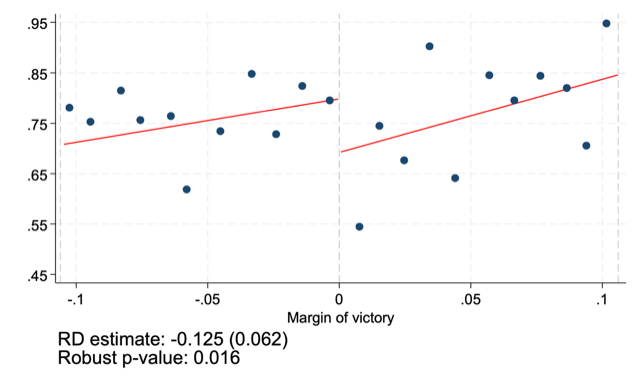
The study finds that when candidates from Pentecostal-linked parties narrowly win mayoral elections, municipal schools become 12.5 percentage points less likely to offer sexual education, an 18% reduction relative to the baseline.
Importantly, no comparable change is observed in state schools located in the same municipalities, which are outside the mayor’s administrative control. The authors also find increased turnover among principals in municipal schools, supporting the idea that personnel appointments are an important mechanism through which local political leadership can affect what happens inside schools.
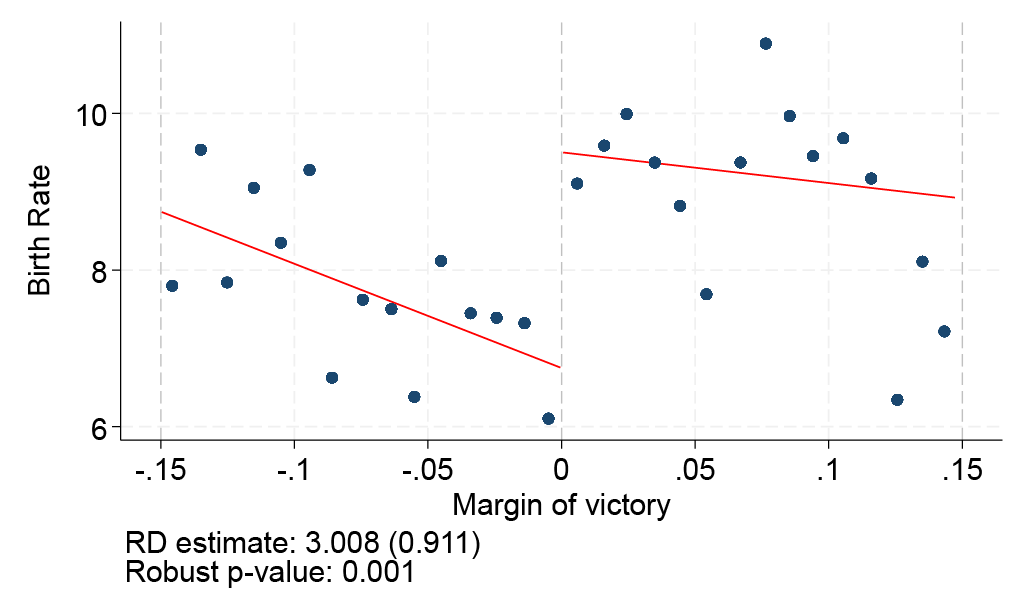
These changes are accompanied by substantial effects on adolescent outcomes. Girls who were aged 9–10 at the time of the election—and therefore spent their middle-school years under the new administration—experience an increase of approximately 3 births per 1,000 girls, about 40% above the baseline rate.
The effect emerges gradually as the exposed cohorts grow older and becomes largest when girls reach ages 14–16. In contrast, the authors find no significant effect for older cohorts who had already passed through middle school when the new mayor took office, providing further evidence consistent with a school-based mechanism.
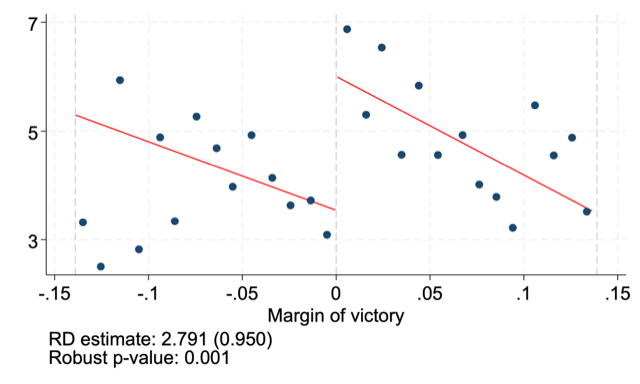
The consequences extend beyond reproductive health. Among girls in the exposed cohorts, dropout in the final years of municipal middle school increases by approximately 2.8 percentage points, from a baseline of around 4%. This represents an increase of roughly 70%.
Again, the pattern is specific to institutions under mayoral control: the researchers find no corresponding increase in female dropout in state schools located in the same municipalities.
The paper documents additional health effects. HPV vaccination coverage among girls most exposed to the new administrations falls by approximately 19 percentage points, while syphilis diagnoses increase among the affected cohorts. At the same time, the authors find no evidence of reductions in contraceptive availability at municipal health centers or similar effects following narrow victories by other right-wing parties.
Taken together, the findings highlight how political control over bureaucratic appointments can shape the delivery of public services even without major legislative or budgetary changes. In this case, discretion over school leadership appears to provide a channel through which political and religious priorities translate into changes in educational provision, with consequences for adolescent health and human capital.
The Revise and Resubmit at the American Economic Journal: Applied Economics marks an important step in the peer-review process for the study and reflects the broader relevance of its contribution to research on education, political economy, religion, and human development.
Readers interested in the details of the study can access the full paper and a short summary of its policy implications:
Both documents are also available in the Publications section of the Human Development Lab website.


